If you're planning a holiday in
Istria in one of our
villas with a private pool and want to experience the history of the place you're visiting, then you should definitely visit
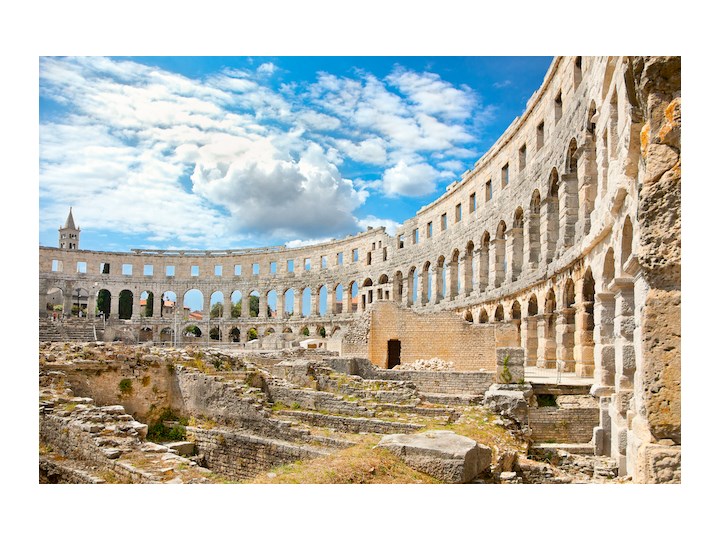
Pula. Here lies one of the most significant and impressive monuments of Roman architecture - the
Pula Amphitheatre, also known as the
Pula Arena, which in its prime could hold up to 23,000 spectators!
The Amphitheatre was commissioned by the first Roman emperor in the 1st century BC and completed during the reign of
Emperor Vespasian in the 1st century AD - the same emperor who commissioned the construction of the Colosseum in Rome. Gladiator fights, executions, and public trials were held in the Arena. It was built from local limestone and is surrounded by many legends. One says that Emperor Vespasian had it built to be closer to his lover, the beautiful slave Antonia Cenida. Another claims that fairies brought the stones from Mount Ucka at night, inspired by the singing of a local fisherman named Zorimir, building the Arena far from human eyes.
Today, it stands as the best-preserved ancient structure in Croatia and one of the most well-preserved
Roman amphitheaters in the world.
The Arena in the Past - A Stage for Gladiators
The Arena was built outside the city walls, only a few meters from the sea, following the motto “panem et circenses” - “bread and circuses.” It is about 132 meters long and 100 meters wide, with an elliptical shape. Most of the structure reaches four levels, while the side built on elevated ground has three. It has retained all four side towers and the majority of the outer walls. As it hosted
gladiator fights, the center featured the arena itself, beneath which were tunnels for keeping wild animals and props for the games. Fights were held even in bad weather and it is interesting to note that the Arena could be covered with a large canvas during such weather, and on hot days, water was sprayed on the audience from cisterns in the towers to cool them down. Admission was free, but seating was strictly based on social hierarchy, with the wealthy seated closest to the arena floor and the poor farthest away. The Arena served both as entertainment and as a demonstration of
Roman power and discipline.
The Arena Today - A Fusion of History and Culture
Gladiator games were banned in the 5th century, and over the following centuries, the Arena's purpose evolved. In the Middle Ages, it hosted
knight tournaments and fairs. Due to its strategic location by the sea and outside the city center, it also served as a defensive fortress. Today, the Arena is an important
cultural and artistic venue. It hosts plays, concerts, operas, and ballets - especially notable is the
Pula Film Festival, held annually since 1954. Thanks to its excellent acoustics and striking ambiance, the Arena has welcomed
international stars like Elton John, Andrea Bocelli, Sting, Eros Ramazzotti, and Arctic Monkeys. During the summer, gladiator game reenactments are held, and the venue is also used for Christmas markets and Easter events.
The underground passages beneath the arena floor are open to the public and feature a permanent exhibition on
ancient olive oil and wine production in Istria.
The ideal time to visit is in spring or autumn. Of course, you can visit in summer too, but expect more crowds. Tickets can be purchased online or at the main entrance, and the visit usually takes between 1.5 and 2 hours.
The Pula Arena is a must-see monument for anyone who appreciates history, art, and culture. Thanks to its remarkable state of preservation, it is more than just a monument - it is alive and breathing even today. If you're planning a holiday in Istria in a
villa with a pool, enrich your stay with a visit to this magnificent structure. Experience the view from the top of the Arena and enjoy a
concert in this
awe-inspiring setting. We are sure it won’t leave you indifferent.
EXPERIENCE HISTORIC ISTRIA!